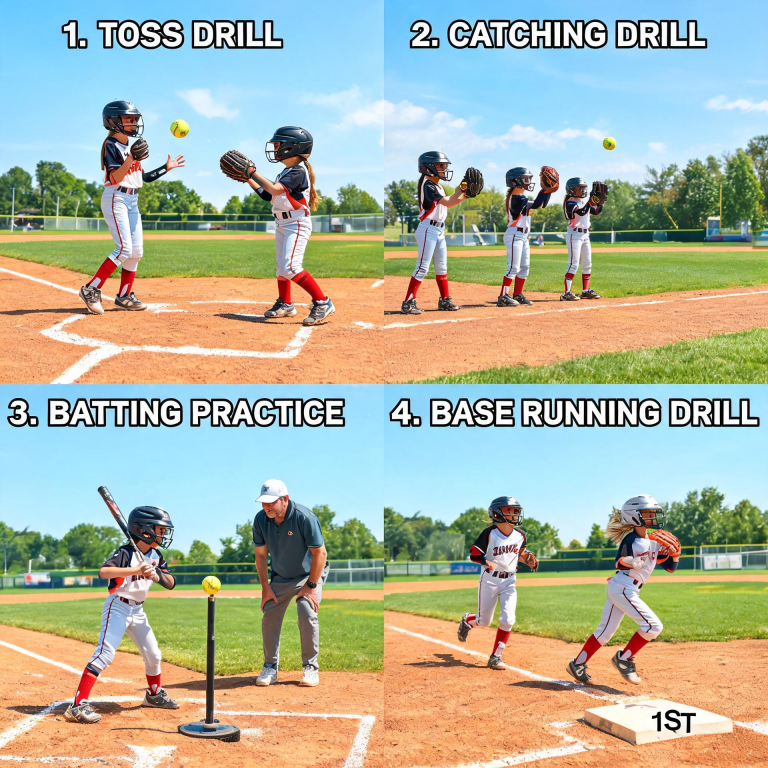
Softball Drills That Survive Game Day
You have seen this player. At practice, she fields forty ground balls in a clean, beautiful row, the kind of rep that makes a coach nod and a parent film it. Saturday comes, a slow chopper takes a bad hop with a runner bearing down on the bag, and she double-clutches. Nothing was wrong with her hands. Something was wrong with the practice. Most softball drills are built to be passed, not to be used, and the difference only shows up once the score is real.
Here is the uncomfortable truth that the standard list of forty softball drills never says out loud: a drill grooves a motion, but a game demands a decision, and those are two different skills. A season of reps that ignores that gap produces a team that looks sharp in warm-ups and vanishes under pressure. This article is about closing the gap — taking the reps you already run and turning them into something that holds up against a real opponent.
Why Your Best Softball Drills Quit at the First Pitch
The tidy single-file line at the cone is the most photographed image in youth softball, and it is also the leak in your practice. When a player fields fifteen identical grounders in a row, she gets very good at fielding that exact grounder. Her brain stops predicting, because there is nothing left to predict. That is called blocked practice, and it feels productive precisely because it makes everyone look competent immediately.
The problem is that competence today and competence on Saturday are not the same thing. Decades of motor-learning research keep landing on the same counterintuitive point: rehearsing one skill over and over in a block makes you sharper this hour and duller next week. Scrambling skills into an unpredictable order — what scientists call high contextual interference — feels worse during the session but produces meaningfully better long-term retention than blocked repetition. The line at the cone wins the practice and loses the game.
The Only Question Worth Asking About a Drill
Before you run anything, ask one question of it: what decision does this force? If the honest answer is “none,” you are not running a drill. You are running a chore that happens to involve a ball. A grounder a fielder knows is coming, to a spot she knows, at a speed she knows, trains her hands and absolutely nothing above the neck.
This single question reorganizes how you judge every drill you own. The best softball drills are not the ones with the cleverest setup or the coolest name. They are the ones that refuse to tell the player what happens next. Add an unknown — which base, which hop, which pitch, how much time — and a mechanical chore becomes a rehearsal for the thing she will actually face.
Fielding: Trade the Bucket Line for a Read
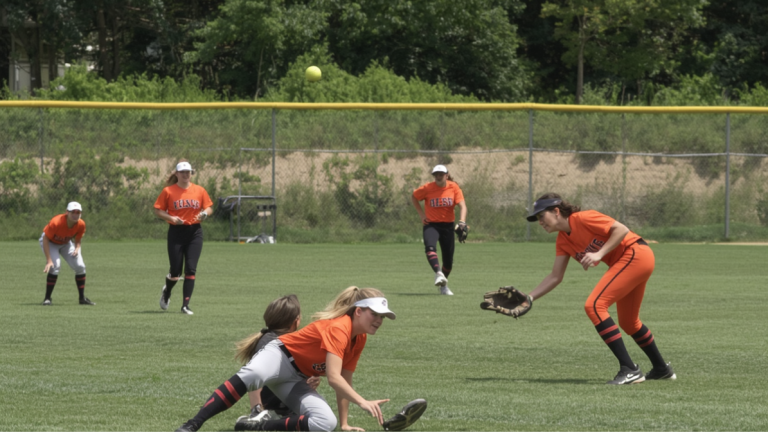
Take the classic Ozzie drill, where an infielder on her knees works short hops in a half-moon. It is excellent for soft hands, and it is blocked to the bone. Keep it as a warmup, then immediately ruin its predictability. Stand off to the side and roll balls without announcing direction, mixing forehand, backhand, and in-between hops at random. Now her eyes lead her hands instead of her memory leading both.
Better still, put a stake in it. “Knockout” fielding — field a clean ball and stay, boot it and sit — adds the one ingredient a bucket line removes: a consequence. Then layer in a live runner sprinting down the line so the fielder has to decide whether the play is even there. Suddenly the same ground ball carries a clock, a body, and a choice. That is the version that shows up in the box score.
Hitting: Put Back What the Tee Removes
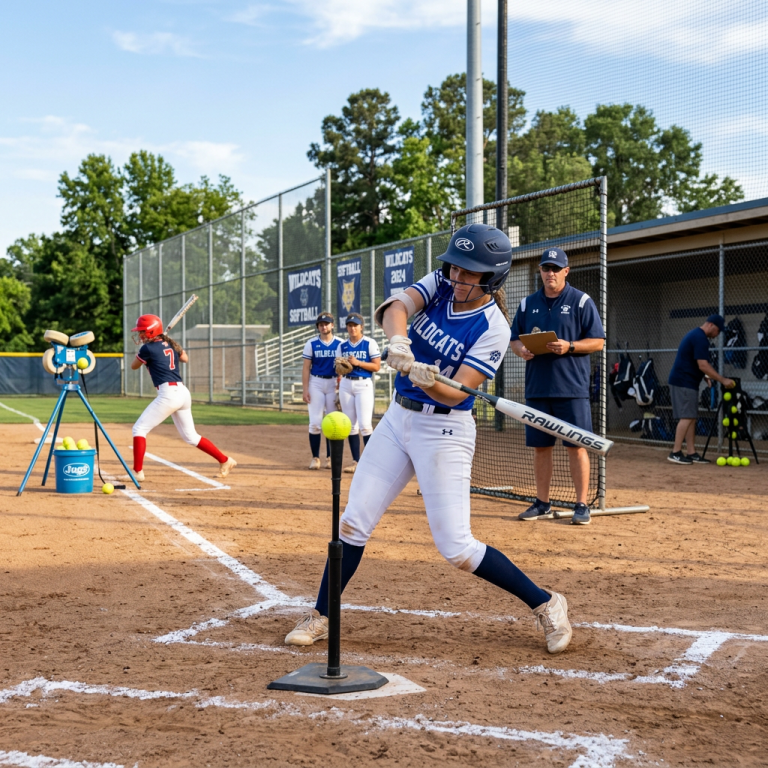
A tee is the most honest teacher of bat path you will ever find, and the most dishonest preparation for hitting a moving ball. The tee removes timing, removes pitch recognition, removes the half-second of doubt that decides at-bats. Hitters who live on the tee build gorgeous swings that have never once had to start on time.
So put the missing pieces back. After a few tee reps to feel the path, switch to front toss where you vary speed and location without calling it out. Better yet, run a recognition drill: soft-toss two ball colors and let the hitter swing at one and take the other. She is no longer rehearsing a swing — she is rehearsing a judgment, made in the window a real pitch gives her. Pitch recognition is a window measured in tenths of a second, and no amount of tee work widens it. The swing was never the hard part. The decision to swing was.
Throwing and Baserunning: Drills With a Clock on Them
Throwing accuracy collapses under hurry, so practice it hurried. Step-back throwing, where partners take three steps apart after every clean catch, quietly stretches arm strength while a missed target ends the streak — a small consequence that pulls focus tight. For footwork, never let a player throw from a set, comfortable base; make her field on the move and throw across her body, because that is the throw a game asks for. A throw made flat-footed in a quiet drill is a throw your shortstop will never actually get to make.
Baserunning is where reads matter most and get drilled least. Do not time players running a straight line; that is a fitness test, not a skill. Instead, stand at second with a ball and have the runner at first react to a coach’s live read — go on a ball in the dirt, freeze on a line drive, read the angle off the bat. Speed is a gift. Reading the play is the skill that turns the gift into a run.
How to Rebuild Your Softball Drills Around Chaos
You do not need a new binder of softball drills. You need to run the ones you have with three filters laid over the top. First, randomize: stop doing one skill until it is “done” and start interleaving skills in an order the player cannot predict. It will look messier and it is supposed to.
Second, attach a consequence: a streak to protect, a score to chase, a partner counting on the play. Pressure is not something you hope appears on game day; it is something you manufacture on Tuesday. Third, shrink the gap: every drill should look a little more like the moment it is preparing for than the drill that came before it. Picture it in one block: a fielder takes a short-hop warmup, then without warning you mix in a backhand, call a base mid-roll, and turn a runner loose — three skills and a decision folded into ninety seconds, on the same dirt with the same bucket. Run those three filters over your softball drills and the boring half of practice quietly becomes the half that wins close games. The point of practice was never to look good at practice.
Softball Drills: The Questions Coaches Actually Ask
How many softball drills should one practice include?
Fewer than you think, run harder than you want. Three or four drills carried through with real intensity, randomization, and a consequence will outperform a parade of ten stations every time. Stacking softball drills back to back mostly buys you the feeling of a full practice while players stand in lines. The best softball drills earn their place by what they demand of a player, not by how many you can cram into ninety minutes. Pick a few, make every rep cost something, and rotate fast.
Are blocked, repetitive softball drills ever worth it?
Yes — early and briefly. When a player is learning a brand-new movement, blocked repetition helps her build a stable pattern before the chaos arrives, and beginners genuinely need that runway. The mistake is living there. Use the tidy, repetitive version to introduce a skill, then get out and add unpredictability before it becomes the only thing she can do.
What are the best softball drills for a young or beginner team?
Ones that are simple to explain in thirty seconds, quick to set up, and impossible to do while bored. For 8U and 10U, lean on the basics with a game wrapped around them — a fielding relay that keeps score, a tee progression that ends in a soft-toss “swing or take.” The youngest players still need reps to build the pattern, so add the chaos in small doses rather than all at once.
How do I know if my softball drills are actually working?
Stop watching practice and start watching games. If your team executes cleanly in the drill line and unravels the moment a live runner, a bad hop, or a real count enters the picture, your softball drills are training the wrong thing. The only honest scoreboard for a drill is what survives to Saturday.