Tell a hitter she is rolling over the ball and watch where her eyes go — straight down to her hands. It is the wrong place to look. The hands are the last thing to move in a swing and the least responsible for what it does. Bat speed, real power, the late barrel that drives a ball into the gap — almost none of it lives in the arms. Most softball hitting drills are built around the part of the body that finishes the swing, then everyone wonders why the swing has no engine.
Here is the misunderstanding buried in the standard list of softball hitting drills: hitting gets coached as a hands-and-wrists skill, a matter of bat path and snap. But a swing is a sequence — a wave of force that starts at the dirt and reaches the barrel last. Fix the sequence and the hands stop being the problem. Drill the hands alone and you are polishing the hood of a car with no motor.
Your Swing Doesn’t Start Where You Think
A good swing is a chain that fires from the ground up. The back leg pushes into the dirt, that force rolls into the hips, the hips pull the torso around, the torso slings the arms, and only at the very end do the hands whip the barrel through the zone. Each link borrows speed from the one beneath it and hands it upward, faster, like a bullwhip. The crack at the end is loud, but the energy was made at the handle. Slow-motion any college hitter and you can see it: the back hip starts to open while the hands are still tucked and waiting, patient, until the very last instant.
Break the order and the whole thing leaks. A hitter who fires her hands before her hips has cut the cable between the engine and the wheels. She will swing as hard as she can and the ball will go nowhere, because effort applied in the wrong sequence is just noise.
Why Most Softball Hitting Drills Train the Last Link
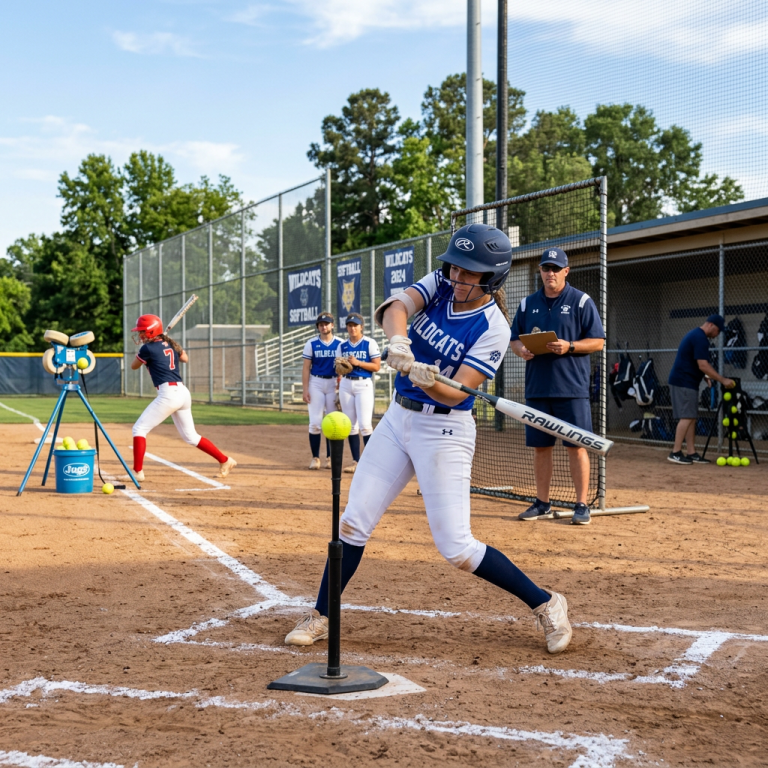
Walk into any cage and count the reps spent on the top of the chain. Tee work, soft toss to the front hip, kneeling drills designed to isolate the upper body — they all train the hands and arms in a body that is sitting still. They are not useless. They are wonderful for feel and a fine way to wake up the barrel. But a steady diet of them quietly teaches a hitter that the swing is an arm action, and that lesson is hard to unlearn.
The tell is the kneeling drill, beloved across the standard softball hitting drills lists precisely because it removes the lower body. That is the exact thing you most need to train. Take away the legs and you have removed the engine to practice steering. It feels productive because the contact looks clean. It is clean because nothing hard is being asked of the part that actually generates power.
The Engine Is in the Ground
This is not a coaching opinion; it is measurable. When researchers put hitters on force plates and tracked the swing, they found that the force a batter drives into the ground through her lead leg is one of the strongest predictors of bat speed at contact, with the lead leg generating and transferring force up the kinetic chain to accelerate the bat. The barrel goes fast because the ground got pushed hard. The hands are along for the ride. That single finding reorders a practice plan: the legs and front side deserve the bulk of the reps, and the softball hitting drills that ignore them are training everything except the source of the power.
So the real question for any drill is brutally simple: where in the chain does it work? If the honest answer is “the hands,” you have a touch-up drill, not a power drill. The most valuable softball hitting drills start at the feet and the front side, because that is where the speed is born and where almost no practice time goes.
Drills That Build the Sequence, Not the Pose
Start under the hands entirely. Rotational medicine-ball throws against a wall teach the body to fire hips-then-torso with no bat to hide behind — the kid who throws it with her arms gets nothing on the wall and feels it instantly. Then bring the bat back with a load-and-go: an exaggerated coil into the back hip, a deliberate pause, then a hard drive into a firm front leg. The pause is the point, because it forces her to feel the sequence in order instead of blurring it. A coach can even hold the bat barrel for a beat at launch so she has to win the tug-of-war with her lower half, not her arms.
Add a walk-through swing, stepping into the ball so she learns to plant a stiff lead leg and let the ground stop her momentum and redirect it up. Finish with a front-side drill where the lead leg has to brace and the hands fire last. These are the softball hitting drills that look strange and build hitters who do not — because they rehearse the wave, not the photograph at contact.
Put the Chain Under a Clock
A sequence is only useful if it fires on time. Once the order feels natural, make it happen against a moving ball, because a swing that sequences beautifully off a tee can still collapse when it has to start early. Front toss at varying speeds forces the load to begin sooner than feels comfortable, which is exactly what a real pitch demands. The goal is an early, unhurried load that lets each link fire in turn — rushed hitters skip straight to the hands and lose the engine all over again. The best softball hitting drills marry the two, a grooved sequence and a moving target, so the chain that fires on the tee still fires when a pitcher is trying to fool her.
Building Softball Hitting Drills That Carry Into Games
Three rules turn ordinary cage work into something that adds pop. First, build bottom-up: start your session with the legs and hips, not the tee, so the engine gets the freshest reps. Second, coach force, not positions — stop hunting the perfect pose at contact and start asking whether she drove the ground and arrived on a firm front side. Third, test it moving, against toss and live pitching, so the sequence holds up under a clock. Run those rules over your softball hitting drills and the pop that shows up in the cage finally shows up in the box score. A pretty swing was never the goal. A loud one is.
Softball Hitting Drills: The Questions Coaches Ask
What softball hitting drills actually build power?
The ones that train the lower half and the sequence — rotational throws, load-and-go, walk-throughs, and firm-front-side drills. Power is generated at the ground and transferred up the body, so reps that ignore the legs cannot build it no matter how many you do. If a drill keeps the hitter still from the waist down, it is grooving contact, not creating force.
Is tee work bad? Should I stop using it?
Keep it, but demote it. The tee is the best tool on earth for feeling bat path and a few clean reps, and a terrible main course because it lets the lower half fall asleep. Use it to start a session or fix a specific flaw, then get to drills that load the legs and fire the chain. The tee is a tuning fork, not the song.
My hitter swings hard but has no pop — what softball hitting drills help?
That is almost always a sequence problem, not an effort problem. She is likely firing her hands before her hips, spending her strength before the chain can multiply it. Slow her down with load-and-go and pause drills so she feels the order, then add rotational throws to teach the body to lead with the bottom half. The hard swing is already there; it just needs to arrive in the right order.
How young can players start sequence-based softball hitting drills?
Earlier than most coaches think, as long as it stays simple and playful. An eight-year-old will not master hip-shoulder separation, but she can throw a medicine ball, step and swing, and feel her back foot push. Keep softball hitting drills for young players movement-rich and game-like, and you build the engine before bad arm-only habits ever set in. Make it a contest — who throws the medicine ball farthest, who sticks the firmest front leg — and the sequence sneaks in while they think they are only competing.